
7 Mistakes You’re Making with PFAS Protection (and How to Fix Them)
Per- and polyfluoroalkyl substances (PFAS) are a growing concern for Texas homeowners. These "forever chemicals" do not break down in the environment or the human body. In April 2024, the EPA finalized new national standards for six types of PFAS in drinking water. Many public water systems in Texas already exceed these new limits. While utilities have until 2029 to comply, you can take steps now to protect your home.
Mistakes in water treatment can leave your family exposed. Use this guide to identify and fix common errors in PFAS protection.
1. Relying on Standard Water Pitchers
Many homeowners believe any water filter removes PFAS. This is incorrect. Standard carbon pitchers and basic refrigerator filters are designed for taste and odor. They remove chlorine but are often ineffective against microscopic PFAS compounds.
PFAS molecules are extremely small and persistent. They require specialized filtration media. If you use a basic pitcher, you are likely still consuming these chemicals.
How to fix it:
Stop using uncertified pitchers for PFAS protection. Upgrade to a high-quality water purification system. Ensure the system is specifically rated for PFAS reduction.
2. Ignoring NSF/ANSI Certifications
Do not trust marketing claims on a box without verification. Manufacturers often use vague language like "reduces chemicals." For PFAS, you must look for specific independent certifications.
The two most important certifications for PFAS are:
- NSF/ANSI 53: For carbon filtration systems.
- NSF/ANSI 58: For reverse osmosis systems.
These certifications prove the system was tested to reduce PFOA and PFOS to below 70 parts per trillion. Many generic systems sold online lack these credentials.
How to fix it:
Verify the certification of any system before purchase. Look for the NSF or WQA (Water Quality Association) gold seal. Honest Water of Texas provides systems that meet these rigorous standards.
3. Using Single-Stage Filtration

PFAS protection requires a multi-layered approach. A single carbon block can become "saturated" quickly. Once saturated, it can no longer trap contaminants. Some systems may even start releasing trapped chemicals back into the water.
The most effective protection comes from a combination of technologies. A reverse osmosis system is the industry standard for this reason.
How to fix it:
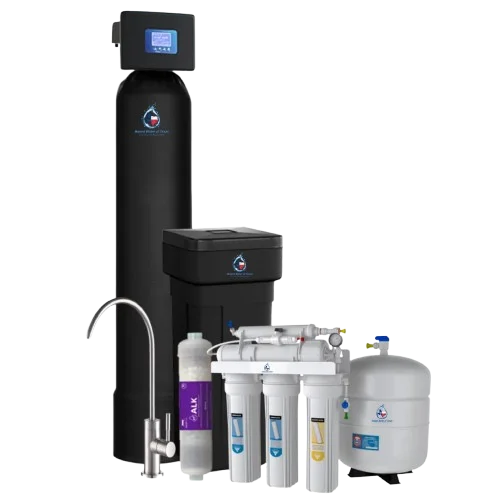
Install a multi-stage system. A proper setup includes:
- Sediment Pre-filter: Removes dirt and rust.
- Carbon Block: Removes chlorine and larger organic compounds.
- RO Membrane: Removes 99% of dissolved solids, including PFAS.
- Post-Carbon Filter: Polishes the water for a final clean taste.
Our Alkaline Filter options use 0.0001-micron precision to ensure maximum contaminant removal.
4. Attempting Whole-House Reverse Osmosis
It is a mistake to try and run your entire home on a standard Reverse Osmosis (RO) system. RO systems generate a "concentrate" or waste stream. For every gallon of pure water produced, several gallons are sent down the drain. Running toilets and showers on RO is wasteful and expensive.
Furthermore, RO water is aggressive. It can leach metals from copper pipes if not properly re-mineralized.
How to fix it:
Use a "Point-of-Use" (POU) approach for PFAS. Install your RO system under the kitchen sink. This provides pure water for drinking and cooking where you need it most. For the rest of the house, use a filtration system like the IntelliClear 600 to handle sediment and chlorine.
5. Neglecting the Maintenance Schedule

A water system is only as good as its filters. Many Texas homeowners install a system and forget it for years. Over time, the RO membrane can foul, and carbon filters lose their ability to adsorb PFAS.
If you do not change your filters, your water quality will drop. You may eventually have the same PFAS levels in your "filtered" water as your tap water.
How to fix it:
Follow a strict maintenance schedule.
- Pre-filters: Every 6–12 months.
- RO Membranes: Every 2–3 years.
- Post-filters: Every 12 months.
If you have a high-demand household, check your filters more frequently. Systems like the ProLine Plus are designed for long life, but still require periodic inspection.
6. Not Testing Your Water Quality
You cannot see, smell, or taste PFAS. The only way to know if your system is working is to test. Many people assume their system is fine because the water "tastes good." Taste is a poor indicator of chemical safety.
Texas water varies greatly by region. Some areas have high TDS (Total Dissolved Solids) which can wear out your PFAS protection systems faster.
How to fix it:
Use a TDS meter to check your RO system’s performance. A high TDS reading often indicates the membrane is failing. For specific PFAS testing, consider a lab-certified home test kit once a year. This is especially important for those on private wells.

7. Assuming Water is the Only Source
Water is a primary pathway for PFAS, but it is not the only one. Homeowners often spend thousands on water filtration while continuing to use high-PFAS consumer products. If you filter your water but cook on scratched non-stick pans, you are still being exposed.
How to fix it:
Adopt a holistic approach to PFAS reduction.
- Replace old non-stick cookware with ceramic or stainless steel.
- Avoid grease-resistant food packaging when possible.
- Choose "PFAS-free" labels for carpets and textiles.
Summary of Actions
| Mistake | Fix |
|---|---|
| Using basic pitchers | Upgrade to a certified RO system |
| Buying uncertified units | Check for NSF/ANSI 53 or 58 |
| Single-stage filtration | Use a multi-stage RO system |
| Whole-house RO | Use Point-of-Use for drinking water |
| Skipping maintenance | Change filters every 6–12 months |
| Not testing | Use a TDS meter or lab test |
| Ignoring other sources | Reduce PFAS-containing products |
Protecting your Texas home from PFAS requires the right equipment and the right habits. Visit Honest Water of Texas to see our full range of solutions. We provide honest assessments and straightforward pricing to help you find a system that fits your budget and needs. Call us at 1-877-804-7336 to start your water quality improvement today.