Reverse Osmosis Vs Bottled Water: Which Is Better For Your Texas Home?
If you buy bottled water every week, you may be considering a reverse osmosis system for your home. Both options can provide drinking water with improved taste. They work in different ways, however.
Bottled water gives you a ready-to-use supply. Reverse osmosis gives you treated water directly from your kitchen faucet.
For most Texas homeowners, an under-sink reverse osmosis system is the better long-term option. It can reduce specific contaminants, lower your ongoing costs, and reduce the need for single-use plastic bottles.
What Is Reverse Osmosis?
Reverse osmosis, or RO, is a filtration process that pushes water through a semipermeable membrane. The membrane reduces many dissolved substances, including certain salts, minerals, metals, and other contaminants.
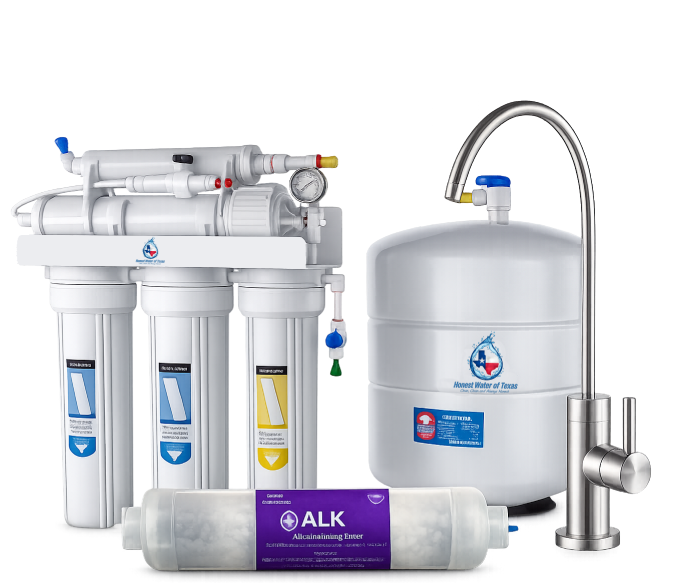
Most residential RO systems include several stages:
- A sediment filter removes larger particles.
- A carbon filter reduces chlorine, taste, and odor.
- The RO membrane reduces dissolved solids and other contaminants.
- A post-filter improves taste before the water reaches your faucet.
- An optional remineralization or alkaline filter adds selected minerals back into the water.
Most systems are installed under the kitchen sink. They provide treated water through a separate faucet for drinking and cooking.
RO is not usually a whole-home solution. It treats water at one point of use. Your showers, laundry, toilets, and other fixtures continue to use regular household water.
How Bottled Water Compares
Bottled water is regulated by the Food and Drug Administration. Municipal tap water is regulated under federal and state drinking water requirements. Both sources must meet applicable standards, but the water treatment process and reporting information can differ.
Some bottled water comes from protected springs. Other bottled water starts as municipal tap water and receives additional treatment. Check the label and the company’s water quality report to identify the source and treatment method.
Bottled water may be useful in specific situations. Keep it available for emergencies, travel, or a short-term boil-water notice. It is less practical as your permanent home drinking water supply.
Reverse Osmosis Vs. Bottled Water: Cost
The cost difference becomes clear when you compare regular use.
A family that buys several cases of bottled water each month may spend hundreds of dollars each year. Depending on the brand, package size, delivery fees, and household consumption, annual costs can reach $500 to $1,000 or more.
A residential RO system generally requires:
- An initial equipment and installation cost.
- Filter replacements every 6 to 12 months.
- Membrane replacement every few years.
- Occasional system checks and sanitizing.
Filter and membrane costs vary by system. Many homeowners spend approximately $50 to $200 per year on maintenance.
Your exact savings depend on how much bottled water you buy. Use this simple comparison:
| Expense | Reverse osmosis | Bottled water |
|---|---|---|
| Initial cost | Equipment and installation | No equipment |
| Ongoing cost | Filters and membrane | Repeated purchases |
| Storage | Under-sink space | Pantry, garage, or refrigerator space |
| Long-term cost | Usually lower | Usually higher |
| Price per gallon | Typically a few cents to a few tenths of a dollar | Often $1 or more |
Calculate your current bottled water spending. Include delivery charges and purchases made away from home. Compare that total with the installation price and estimated maintenance cost of an RO system.
If your household already buys bottled water regularly, the system may recover its cost within the first few years.
For more cost-saving ideas, read 15 Ways a Reverse Osmosis System Saves You Money and Stress.
Water Quality and Contaminant Reduction
Reverse osmosis can reduce many dissolved contaminants. The exact performance depends on the system design, the incoming water, the membrane, and proper maintenance.
Do not select a system based only on a general claim such as “purifies everything.” Review the performance data for the contaminants that concern you.
Look for:
- NSF/ANSI 58 certification for reverse osmosis systems.
- Carbon filtration for chlorine, taste, and odor.
- Specific certification for lead or other health-related contaminants.
- Filter replacement instructions.
- A system capacity that matches your household use.
- A professional water test before installation.
If you are concerned about lead, review your local water quality report and consider testing your tap water. The EPA states that lead cannot be seen, tasted, or smelled. Testing is the only way to confirm whether lead is present in harmful quantities.
Read the EPA’s Basic Information About Lead in Drinking Water for testing and filter-use guidance.
Bottled water can also vary. Read the label and the available quality report. Do not assume that a higher price means better treatment.
Texas Water Requires a Practical Setup
Texas homes often deal with hard water. Hard water contains calcium and magnesium. These minerals can create scale on fixtures, leave spots on dishes, and reduce the efficiency of water-using appliances.
Reverse osmosis can reduce hardness in the water it treats. It does not protect every fixture in your home because it usually serves only the kitchen faucet.
If your home has hard water, consider using a water softener before the RO system. A softener treats the water throughout the home and reduces the mineral load entering the RO membrane.
This combination can provide:
- Softened water for showers, laundry, and appliances.
- Treated drinking and cooking water at the kitchen sink.
- Better protection for the RO membrane.
- Less scale on plumbing and fixtures.
- Improved taste and reduced dissolved solids at the drinking faucet.
Read How a Water Softener Can Save Your Texas Home to learn how softening and RO serve different purposes.

Wastewater and Plastic Waste
Bottled water does not create wastewater in your home. It does create packaging waste and requires repeated manufacturing, transportation, storage, and disposal.
Reverse osmosis sends some water to the drain during filtration. The amount depends on the system’s recovery rate, water pressure, membrane condition, and installation.
Traditional systems may use several gallons of feed water to produce one gallon of treated water. High-efficiency systems can reduce that ratio. Ask about the system’s water efficiency before you purchase it.
At typical municipal water rates, the added water cost is often small compared with regular bottled water purchases. You can also ask your installer whether the reject water can be directed to an appropriate non-drinking use, such as landscape watering, where local plumbing requirements allow it.
Replace filters on schedule. A clogged or poorly maintained system may waste more water and provide lower performance.
Maintenance Requirements
Reverse osmosis requires regular maintenance. Follow the manufacturer’s schedule.
Complete these tasks:
- Replace sediment and carbon filters as directed.
- Replace the RO membrane when performance declines.
- Check tubing and connections for leaks.
- Sanitize the system at the recommended interval.
- Monitor water taste and flow.
- Check TDS readings if your system includes a TDS display or meter.
A TDS reading shows the amount of dissolved material in water. It does not identify every contaminant and should not be used as a complete water quality test. A sudden change can indicate a filter or membrane problem.

Bottled water requires no equipment maintenance. You must still purchase, carry, store, and dispose of the bottles. Choose the option that fits your household’s available time and storage space.
When Bottled Water Is the Better Short-Term Choice
Bottled water can be the right choice when:
- A boil-water notice is active.
- Your water system is being repaired.
- You are preparing an emergency supply.
- You are traveling.
- Your RO system requires service.
- A confirmed contamination issue has not been resolved.
During a boil-water notice or other public health emergency, follow instructions from your local water utility or health department. Do not assume that an RO system alone resolves every emergency condition.
For everyday use, a properly selected and maintained RO system provides water on demand without regular case purchases.
Which Option Is Better for Your Texas Home?
Choose reverse osmosis if you want a long-term drinking water solution with:
- Lower ongoing costs.
- Less single-use plastic.
- A dedicated source for drinking and cooking.
- Reduction of specific dissolved contaminants.
- Consistent water available at your kitchen sink.
- Optional remineralization or alkaline filtration.
Use bottled water as a backup. Do not rely on it as your only plan if your household consumes large amounts of water.
The best setup depends on your water source, water test results, household size, budget, and maintenance preferences. Municipal water and private well water require different evaluations. Hard water may also require a softener before an RO system.
Start with a water test. Review the results. Compare certified equipment and maintenance requirements. Ask for a clear recommendation and straightforward pricing.
Honest Water of Texas provides water softeners, filtration systems, and reverse osmosis solutions for Texas homes. Visit our reverse osmosis information or contact Honest Water of Texas to discuss your options without a high-pressure sales process.
For more information, read The Ultimate Guide to Water Purification Systems in Texas.
Frequently Asked Questions
Is reverse osmosis water better than bottled water?
For many Texas households, RO is the better long-term option. It can reduce specific contaminants, cost less over time, and reduce plastic waste. Performance depends on system selection and maintenance.
Does reverse osmosis remove hard water?
RO can reduce hardness in the water it treats. An under-sink system does not treat water throughout the home. Use a water softener for whole-home hard water control.
How often do RO filters need to be replaced?
Many pre-filters are replaced every 6 to 12 months. The membrane may last 2 to 5 years. Follow the instructions for your specific system and water conditions.
Should you keep bottled water at home if you have RO?
Yes. Keep bottled water for emergencies, boil-water notices, travel, or temporary system maintenance. Follow local public health instructions during an active water advisory.
Does a TDS meter prove that water is safe?
No. A TDS meter measures dissolved material. It does not identify individual contaminants or confirm that water meets every health standard. Use laboratory testing and certified filtration claims for a complete evaluation.